
LED Work Lights for Construction and Industrial Vehicles: A Buyer’s Guide
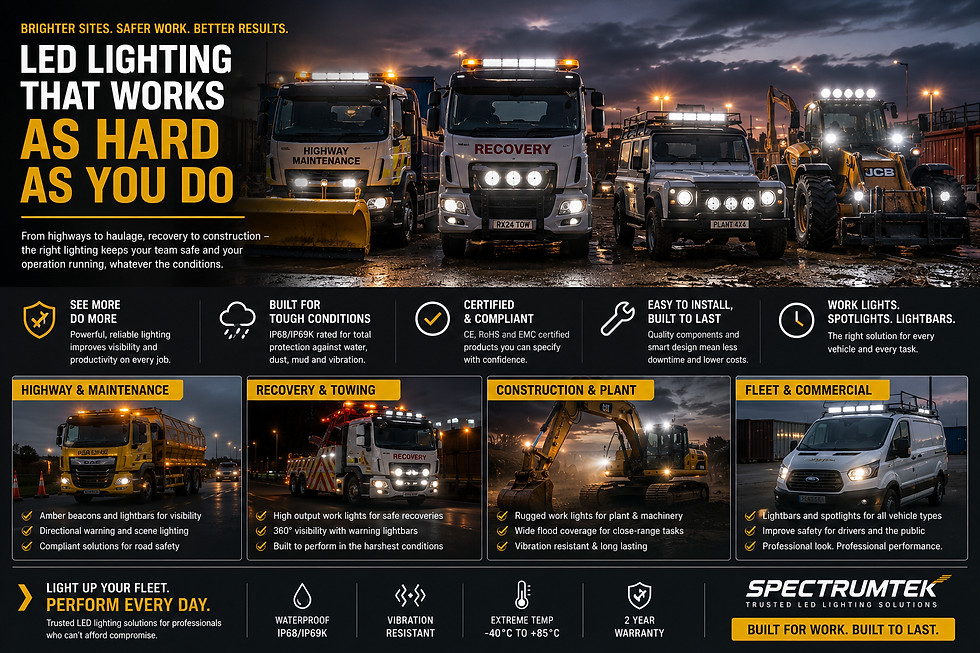
Construction and industrial vehicles — excavators, telehandlers, dumpers, cranes and site plant machinery — operate in an environment that combines heavy vibration, dust, mud, and frequently, extended night or low-light shift work, making LED work lighting a genuinely operational rather than optional consideration for site safety and productivity. Selecting the right work lighting for this sector requires weighing durability, coverage and certification specifically against construction site conditions.
Why Site Conditions Demand Specialist Consideration
Construction sites present an unusually harsh combined environment for vehicle lighting: heavy dust and airborne particulate from earthworks and demolition, frequent exposure to mud and standing water, sustained vibration from operating heavy machinery and traversing uneven ground, and in many cases, extended operating hours through winter months when natural daylight is limited. This combination makes basic splash-resistant lighting inadequate for genuine construction site use, regardless of how well such lighting might perform in less demanding applications.
IP69K certification, confirming resistance to high-pressure, high-temperature washdown, matters considerably in this sector given how frequently construction plant is pressure-washed to remove accumulated mud and debris between uses or at the end of a shift — a routine maintenance practice that would rapidly expose any inadequately sealed lighting to water ingress.
Beam Pattern for Site Work Tasks
Most construction and plant machinery work lighting tasks favour wide, even flood coverage over long-range spot throw, since site operations — excavation, material handling, positioning machinery around other plant and personnel — typically happen at close range in a defined working area rather than requiring long-distance visibility down an open route. Multiple flood-pattern work lights positioned to eliminate shadows around the machine’s working area, particularly around the bucket, forks or lifting point depending on machine type, generally provide more practical value than a single high-output light aimed for distance.
For plant that also travels between sites on public roads, a combination of work lighting for on-site tasks and appropriately road-legal driving lights for transport journeys addresses both use cases without compromising either.
Vibration and Mounting Durability
Construction plant machinery generates some of the most sustained and severe vibration any vehicle-mounted lighting will encounter, arising from hydraulic operation, contact with material being excavated or moved, and traversal of genuinely rough, unfinished ground. Work lights and their mounting brackets need to be engineered specifically for this level of sustained mechanical stress, with robust housing construction and properly torqued, thread-locked mounting hardware, since failure in this application is considerably more likely than in standard road vehicle use given the intensity of vibration exposure.
Visibility to Other Site Personnel
Beyond illuminating the machine operator’s own working area, construction site lighting has a secondary but equally important role: making the machine itself visible to other site personnel, plant operators and vehicles moving around a shared, often congested and hazardous site environment. This is a genuine site safety consideration distinct from the operator’s own task illumination, and site safety management increasingly specifies minimum lighting standards for plant operating during low-light hours as part of broader site safety protocols.
Certification and Site Compliance Documentation
Larger construction contractors and site operators increasingly require documented certification for equipment used on site, including lighting, as part of broader health and safety compliance and equipment procurement standards. Being able to provide full CE, RoHS and IP-rating certification documentation for work lighting fitted to plant machinery simplifies this compliance requirement considerably, compared with lighting lacking clear, verifiable certification records.
Electrical Considerations for Plant Machinery
Construction plant electrical systems vary considerably by machine type and age, and adding auxiliary work lighting should follow the same principles applied across any vehicle retrofit: a properly specified wiring kit with correctly rated relays and fuses matched to the lighting load, using sealed, waterproof connectors throughout given the site conditions the machine will operate in. Machines with hydraulic or electronic control systems benefit particularly from EMC-certified lighting, reducing the risk of electrical interference with increasingly sophisticated onboard machine control electronics.
Maintenance Scheduling Across a Plant Fleet
Larger plant hire and construction fleet operators benefit from folding lighting inspection directly into existing scheduled maintenance intervals for each machine, rather than treating lighting as a separate, informally managed system checked only when a fault is reported. Given how routinely construction plant already undergoes scheduled servicing for hydraulics, engine systems and structural inspection, adding a brief lighting and mounting hardware check to this existing schedule represents minimal additional administrative burden while catching developing lighting or mounting issues before they cause an in-service failure during active site work.
This approach also supports better record-keeping for site safety compliance purposes, since a documented maintenance history covering lighting condition alongside other scheduled machine checks provides straightforward evidence of proactive safety management if ever required during a site audit or incident investigation.
Light Spill Considerations Near Residential and Sensitive Sites
Construction sites operating in or near residential areas, particularly during extended winter working hours when darkness falls before a shift ends, face a genuine practical consideration around light spill affecting neighbouring properties. While this is primarily a site management and community relations issue rather than a strict lighting product specification question, the choice of beam pattern and light positioning has a direct bearing on it — tightly controlled flood lighting aimed carefully at the actual working area, rather than widely diffused illumination spilling well beyond the site boundary, reduces the risk of complaints from neighbouring residential properties and can be a meaningful factor in maintaining good community relations for contractors working extended hours on sites near housing.
Some local planning conditions and site-specific agreements increasingly include explicit lighting management requirements for construction sites near residential areas, covering both intensity and hours of use, and site managers should factor this into both lighting product selection and daily operational practice, since a well-specified, properly aimed lighting setup can usually achieve necessary site safety and work visibility while still meaningfully limiting spill beyond the immediate site boundary.
Considerations for Plant Hire Fleets
Plant hire companies face a particular version of the standardisation challenge discussed elsewhere in this guide, since hired machinery moves between different customer sites, contractors and operating conditions far more frequently than plant owned and operated by a single construction business. This makes robust, certified lighting with genuine durability across varied conditions and operators of differing experience levels particularly important for hire fleets, since hire equipment often receives less consistent day-to-day care than owner-operated machinery, and a hire company has less visibility into and control over the specific conditions any individual piece of equipment will face during a given hire period.
Hire companies also carry a distinct commercial incentive to minimise lighting-related faults specifically, since equipment returned from hire with a lighting fault typically needs remedial attention before it can be confidently hired out again, representing lost hire revenue during the repair period on top of the direct repair cost itself. This makes the total cost of ownership argument for certified, genuinely durable lighting particularly compelling for plant hire businesses, where equipment utilisation and availability are central to the underlying business model in a way that differs from single-owner construction fleets.
Operator Familiarity and Training
Even the best-specified work lighting delivers less value if machine operators are not familiar with adjusting or making full use of the lighting configuration available to them, particularly on machinery with multi-zone or independently controllable work lights. Including basic lighting operation as part of standard plant operator induction or training — covering which lights suit which tasks, how to adjust or activate different zones, and what to check for at the start of a shift — ensures the investment in a properly specified lighting setup translates consistently into genuine on-site benefit across a full workforce of operators with varying experience levels, rather than depending on individual operators discovering the system’s capabilities informally over time.
Investing in Lighting as Part of Site Safety Culture
Ultimately, construction and industrial vehicle lighting sits within a much broader site safety culture that responsible contractors and plant operators build across every aspect of their operation. Treating work lighting specification with the same rigour applied to other safety-critical equipment decisions — rather than defaulting to whatever lighting happened to be fitted by a previous owner or hire company — reflects a genuine commitment to operator and site personnel safety that extends well beyond simple regulatory compliance.
Frequently Asked Questions
Q1: Do all construction vehicles need IP69K-rated work lighting, or is IP68 sufficient?
Ans: For machinery subject to regular pressure washdown or heavy mud and water exposure — common on most active construction sites — IP69K provides meaningfully better assurance than IP68 alone, given IP69K’s specific testing against high-pressure, high-temperature jet washing.
Q2: How many work lights does a typical piece of plant machinery need?
Ans: This depends on machine type and task, but most construction plant benefits from multiple flood-pattern lights positioned around key working areas — bucket, forks, cab surroundings — rather than relying on a single light source to cover the full working area.
Q3: Does construction site work lighting need to meet different standards than standard vehicle lighting?
Ans: The underlying electrical and waterproofing certification standards (CE, RoHS, EMC, IP ratings) apply consistently, though many construction contractors layer additional site-specific safety and visibility requirements on top of standard product certification as part of their own site safety management systems.
Construction and industrial vehicle lighting is a genuine safety and productivity investment rather than a simple accessory, and prioritising certified durability, appropriate flood-biased coverage and robust vibration-resistant mounting will consistently deliver better site performance than selecting lighting based on price or lumen figures alone.


Comments