
Single-Row vs Dual-Row LED Light Bars: Performance and Application Differences
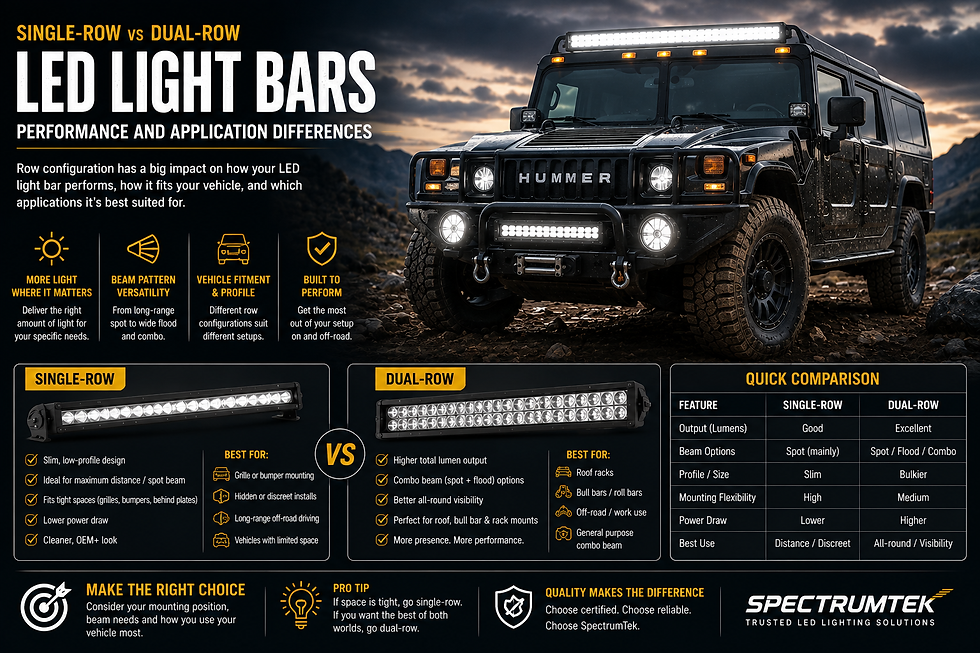
Beyond length, beam pattern and shape, one further specification meaningfully affects how an LED light bar performs and fits: whether it is built with a single row or dual row of LED chips. This is a specification buyers often notice without fully understanding its practical implications, despite it having a genuine effect on both performance characteristics and vehicle fitment.
What Row Configuration Actually Means
A single-row light bar arranges its LED chips in one continuous line along the length of the housing, typically behind a single row of reflectors. A dual-row light bar uses two parallel rows of LED chips, roughly doubling the number of individual LED emitters within a housing of comparable length, each behind its own reflector optics.
This difference in chip density is the source of most of the practical performance and fitment differences between the two configurations.
Output and Beam Characteristics
Dual-row light bars generally deliver higher total lumen output for a given bar length, simply because they contain a greater number of LED emitters within the same physical space. This additional output can translate into either genuinely greater brightness at a given distance, or — depending on how the manufacturer has configured the two rows’ optics — a combination beam pattern, with one row optimised for spot throw and the other for flood coverage, delivering combined beam versatility from a single unit rather than requiring two separate light bars.
Single-row light bars, while generally offering lower total output for an equivalent length compared with a dual-row unit, are not simply a lesser product — for spot-beam-focused applications prioritising maximum throw distance from a more compact, lower-profile unit, a well-engineered single-row bar can outperform a dual-row unit of similar overall power draw, since all its available output is concentrated through a single row of precisely focused reflectors rather than split across two rows with potentially different optical purposes.
Mounting Profile and Vehicle Fitment
Single-row light bars have a notably slimmer, lower-profile housing than dual-row units of equivalent length, which matters for vehicles with limited mounting clearance, aerodynamic or aesthetic considerations, or specific mounting locations such as behind a grille or within a bumper cavity where housing depth is constrained. This slimmer profile has made single-row light bars increasingly popular for more discreet, integrated mounting positions compared with the more visually prominent dual-row alternative.
Dual-row light bars, with their bulkier housing, generally suit more exposed, unconstrained mounting positions — roof racks, bull bars and roll bars — where the additional housing depth does not create a fitment conflict, and where their combined beam versatility and higher total output are genuinely valued for the application.
Power Draw and Wiring Considerations
Given their greater number of LED emitters, dual-row light bars typically draw more current for an equivalent bar length than a single-row unit, which has direct implications for wiring kit specification, as covered in our guide to LED wiring kits. Cable gauge, relay rating and fuse specification should be matched to the actual current draw of the specific light bar being installed, and dual-row units generally require a wiring kit specified for the higher end of the current range compared with an equivalent-length single-row unit.
Application-Based Recommendations
Constrained mounting positions (grille-mounted, bumper cavity, low-clearance applications): Single-row light bars generally offer a more practical fit without compromising as significantly on available output for the space.
Roof, bull bar and roll bar mounting with no space constraint: Dual-row light bars typically deliver a genuine performance advantage where mounting space is not a limiting factor.
Applications prioritising maximum spot-beam throw from a compact unit: A well-engineered single-row bar with a dedicated spot beam configuration can be genuinely competitive with a larger dual-row unit for pure distance-throw applications.
General-purpose combo beam applications with adequate mounting space: Dual-row units offering combined beam versatility from a single housing are a popular, practical choice for buyers wanting both spot and flood characteristics without running two separate light bars.
Cost and Value Comparison Between Configurations
When comparing price between single-row and dual-row light bars of similar length, it is worth evaluating cost relative to genuine usable output and application fit, rather than comparing raw price alone. A dual-row bar’s higher price reflects its additional LED chips and typically higher total output, and represents genuinely better value for applications that will use that additional capability. For a buyer whose mounting position and application genuinely call for a slimmer, single-row unit, paying a premium for a dual-row bar’s additional output offers little practical benefit if that output cannot be effectively utilised in the intended mounting position or use case.
The more useful comparison is therefore not simply price per bar, but price relative to how well the configuration’s inherent strengths — compact profile versus higher combined output — actually align with the specific vehicle and application in question.
What Professional and Emergency Fleet Buyers Typically Choose
Looking at how experienced professional and emergency services buyers approach this decision offers a useful practical reference point. Emergency services vehicles, where both wide scene coverage and long-range hazard identification genuinely matter for operational effectiveness, frequently specify dual-row combination-beam light bars precisely because the combined beam versatility from a single unit simplifies both procurement and vehicle-specific fitting compared with running two separate light bars to achieve the same functional coverage. Agricultural and recovery fleets, where mounting space is less constrained than on a car or standard van, similarly lean toward dual-row units for the same combined-coverage benefit.
Conversely, sectors where mounting space is genuinely constrained, or where a lower-profile, less visually prominent installation is specifically wanted — certain covert or semi-covert operational vehicles, or passenger cars with limited grille or bumper mounting depth — more often specify single-row units despite the lower total output, precisely because the mounting and profile advantage outweighs the output difference for their specific application. This pattern across experienced professional buyers reinforces the guidance above: the right choice depends on matching configuration to genuine application need rather than defaulting to whichever option offers the highest headline specification.
Beyond Dual Row: Triple-Row and High-Density Configurations
A smaller segment of the market extends this same logic further with triple-row and other higher-density LED configurations, packing additional rows of chips into a single housing to maximise total output for a given bar length beyond what a standard dual-row configuration achieves. These higher-density units generally suit applications with genuinely severe illumination requirements and ample mounting space and electrical capacity to support them — certain specialist industrial, defence or large commercial vehicle applications — but represent a smaller, more specialised segment of the market than standard single and dual-row configurations, which comfortably serve the substantial majority of consumer, commercial and off-road applications.
For most buyers, the added cost, weight, mounting depth and electrical draw of triple-row or higher-density configurations are difficult to justify unless a specific, demanding application genuinely calls for output beyond what a well-chosen dual-row unit can provide, making these configurations a niche rather than a mainstream recommendation for the great majority of vehicle lighting needs discussed throughout our other guides.
A Simple Decision Framework
Buyers wanting a quick, practical way to reach a decision can work through three questions in sequence: first, does the intended mounting position have adequate depth and clearance for a dual-row housing, or does a constrained space call for a single-row profile? Second, does the application genuinely benefit from combined spot-and-flood beam versatility, or is a single, more concentrated beam characteristic sufficient? Third, does the vehicle’s electrical system and wiring comfortably accommodate the higher current draw a dual-row unit typically requires? Working through these three questions in order will point most buyers confidently toward the right configuration for their specific vehicle and application without needing to rely on marketing claims or general assumptions about which configuration is inherently superior.
Final Thoughts on Configuration Choice
Row configuration is one of several interconnected specifications — alongside beam pattern, shape, and certification standard — that together determine how well a light bar suits its intended vehicle and application. Considering it in isolation from these other factors risks an incomplete picture, and buyers who work through the full set of relevant specifications together, rather than fixating on row count alone, will consistently arrive at a better-matched final choice for their specific needs.
Frequently Asked Questions
Q1: Is a dual-row light bar always brighter than a single-row bar of the same length
Ans: Generally yes in terms of total lumen output, given the greater number of LED emitters, though beam pattern configuration and reflector quality still meaningfully affect how that additional output translates into usable brightness at a given distance.
Q2: Can a single-row light bar still achieve a combo beam pattern?
Ans: Yes, through varied reflector design along the single row, though dual-row configurations more commonly and straightforwardly achieve this by dedicating each row to a different beam characteristic.
Q3: Does a dual-row light bar require a different wiring kit to a single-row bar?
Ans: Not a fundamentally different type of wiring kit, but the specific cable gauge, relay and fuse rating should be matched to the higher current draw typical of dual-row units compared with an equivalent-length single-row bar.
Choosing between single-row and dual-row configurations ultimately depends on the specific mounting position available and the beam characteristics prioritised for the intended application, rather than one configuration being universally superior to the other.


Comments